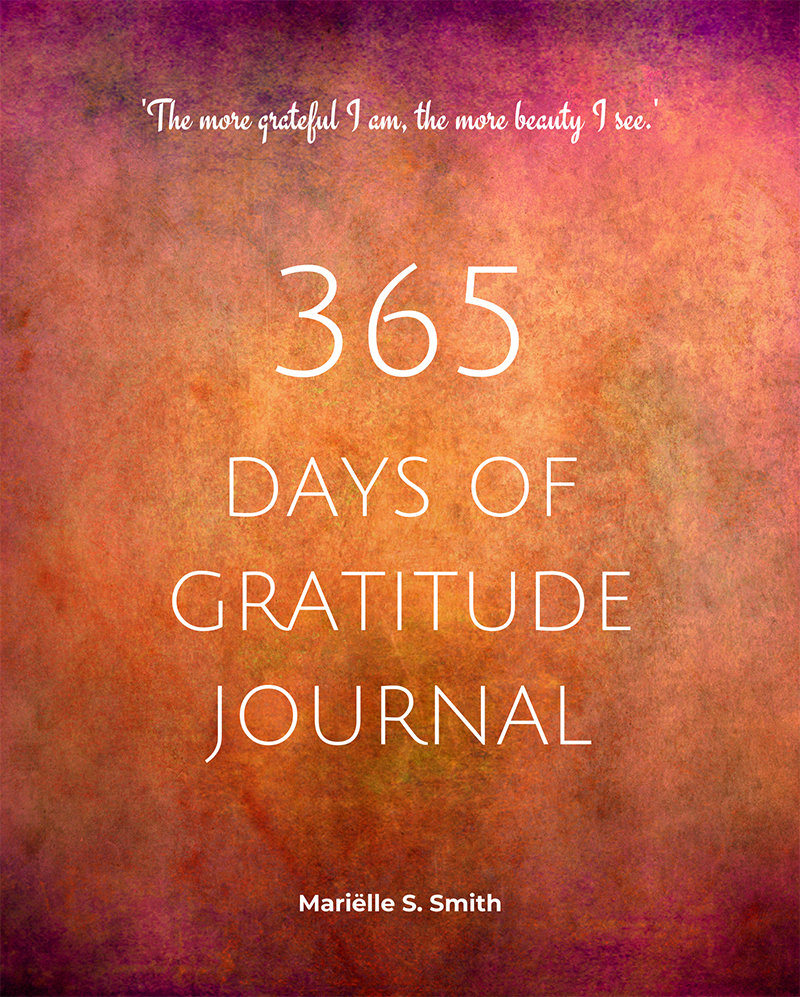
by
Mariëlle S. Smith
~~~~~~~~~~~~~
GENRE:
Non-fiction; self-help
~~~~~~~~~~~~~
BLURB:
***
Now available in black-and-white AND full colour! ***
‘The
more grateful I am, the more beauty I see.’
Mary Davis
Gratitude
is not just about ATTITUDE.
Gratitude is about
PRACTICE.
But how do you create a gratitude practice that
sticks?
After the success of her first 365 Days of
Gratitude Journal, writing coach Mariëlle S. Smith brings you Volume
2. Same journal but with an entirely different look!
After
years of barely surviving her own emotional minefield, Mariëlle
discovered the transformative power of practising gratitude. But,
like no one else, she knows that cultivating an attitude of gratitude
is easier said than done.
365 Days of Gratitude, Vol. 2 is
an undated, guided journal. Complete with inspiring quotes, daily
prompts, and recurring check-ins, it was designed to help you create
a sustainable gratitude practice too.
Commit to the
life-changing power of gratitude today and order your copy now!
Excerpt
Gratitude
journaling brings me so much. It slows me down. It reminds me to take
deep breaths in and out. It stops me from pushing myself too hard,
too often. It brings me joy. Happiness. Appreciation. It reminds me
of all I have going for me, no matter the kind of day it’s been.
It
really has been the key I was looking and ready for when it showed up
in my life.
But,
even now, after years of practice, I have to consciously decide to do
the work. That it came at the right time and with the structure I
needed doesn’t mean I don’t get off track, especially when the
going gets tough.
I
used to become angry and utterly frustrated with myself when this
happened, but now I simply sit myself down (read: force myself to
take a break) and return to my practice. And because it’s such a
simple, structured practice, it’s easier to pick up again than I
often think.
Of
course, some days or even weeks will be easier than others, but
that’s another thing gratitude journaling has brought me. No matter
how far I stray, I am grateful for having something to return to. For
all the days I ignore my practice, I’m grateful for all the days I
do pick up my journal and let the miracle that is life unfold in
front of me.
~~~~~~~~~~~~~
Ornery's Review
Rating: Five out of five stars
This book is your book. It's whatever you need it to be. After the intro by the author, there are 365 pages that you can fill in. You write down three things you are grateful for, give the day a rating, write down something you want to remember about the day, something you could have been more grateful for, and your intention for the next day.
The intent of this journal is not to adhere to strict, inflexible rules. I have a rather cynical outlook on life and tend to see gratitude journaling as either unrealistic or punitive, i.e. "you will be grateful, you ungrateful, selfish harpy! So many people have it worse than you!"
This kind of thinking brings me back to the shame I've felt for as long as I can remember. I once heard the quote that guilt is what you feel about something you've done. Shame is something you feel about what you are. I've never enjoyed "gratitude journaling," because it always reminds me of what I'm not.
This author, however, doesn't make the practice seem punitive. She acknowledges that with any such practice, there may be periods where you don't want to do it, and that's okay. Pick up again when you can.
The author suggests working on the journal in the evening. I'd be more likely to reflect on the previous day in the morning. My sleep has always been fraught with peril, and now that I'm no longer a slave to a time clock, if my body's telling me it's time to sleep, I'm going to listen.
I already have a journaling practice centered more around kvetching and planning. For someone who was shamed for their (misdiagnosed) ADHD for most of their life, this practice is more helpful than I would have believed.
Gratitude journaling is a different thing. It doesn't center on organizing my thoughts or finally acknowledging my past trauma and allowing myself to be disgusted, outraged, and just plain mad about the way I was (mis)treated. As the author says, "It slows me down. It reminds me to take deep breaths in and out. It stops me from pushing myself too hard, too often."
When I stopped punching a time clock and applied for disability three years ago, I was still relentless with myself. I really didn't know who I was without work. I was ashamed of not being able to earn a "proper" paycheck. Some old trauma that I'd suppressed for literal decades rose from the graveyard of my subconscious. Every morning when I woke up, the first "voice" I heard in my mind was the one telling me what a worthless piece of garbage I was.
Would gratitude journaling have helped me get a handle on this sooner?
I don't know, but it's worth a try.
I do most of my writing on the computer. I haven't kept a handwritten journal for years. I'm thinking I might like to print out some blank pages from the journal and get myself a glue stick. I'd like to combine gratitude journaling and drawing. I would do this in the morning, though, because I need to be able to fall asleep when I'm ready.
One might say that I'm grateful for the opportunity to try something new in my efforts to heal from my past abuse.
I appreciate this book and give it five out of five stars.
Guest Post
The
author quote that inspired me to create whatever I want to:
I’ve
always told stories, even before I was taught how to write. Back
then, what others thought of my stories didn’t seem that relevant
to me: I simply shared whatever my imagination conjured up.
Years
later, when I became more serious about writing and began to
entertain the thought that I might want to become a writer, what
others thought felt more relevant. It had me wondering whether there
was ever going to be an audience for what I was writing, whether
anyone was waiting to hear what I had to say.
Obviously,
such worries aren’t exactly conducive to creative flow. It limited
me, as I’m sure they’ve limited others, and had me abandon
projects before I’d properly started them just because I convinced
myself no one would want to read them anyway.
It
didn’t help that I tend towards writing what doesn’t exist yet. A
lot of my inspiration comes from the gaps I sense in other work.
Considering that Toni Morrison once said ‘If there’s a book you
want to read, but it hasn’t been written yet, then you must write
it’, I’m sure I’m not the only writer whose inspiration springs
from what could be.
However,
when you’re writing the books that you feel are missing, you can’t
look at what others are doing to verify that your work will be
welcomed into the world. It takes a lot of trust and perseverance to
write anything;
just imagine how much more you’re going to need when you find
yourself off the beaten path.
For
the longest time, this was one of my main writing struggles. It kept
me from committing to numerous ideas, even if they kept nagging me
from the far corners of my brain I had banished them to.
And
then I came across this quote by Paulo Coelho:
If
it’s still in your mind, it is worth taking the risk.
Not
only did it make my heart skip a few beats, it brought all those
ideas that had been vying for my attention over the years to the
forefront of my mind. With a vengeance. And now they knew I knew
about Coelho’s words, they refused to go anywhere else.
These
ideas had always known it was worth taking the risk. That’s why
they stayed in my mind for so long. But now I knew it too.
And
that’s when I surrendered. These days, if an idea keeps poking at
me for long enough, I’ll give it a go. That’s right, I don’t
just entertain any idea that pops up in my head. On the contrary,
Paulo Coelho’s words allowed me to create a sort of litmus test to
separate worthy ideas from mere distractions.
This
is how that litmus test works in practice:
Part
of one of the walls in my office is dedicated to ‘New ideas’.
Whenever an intriguing idea comes to me, I write it down on a sticky
note and put it up on that bit of wall. I
then walk away from it and continue working on whatever I’d been
occupied with before the idea decided to distract me.
If
an idea keeps popping up in my head over the next couple of weeks or
months, I’ll give it some serious thought. I’ll grab a notebook,
make myself some tea, and give it my undivided attention for a while
to see if it turns into something more concrete, something I actually
feel like writing.
If
not, if I check my wall with sticky notes and find ideas I haven’t
given a single thought since putting them up there, I pull them down
and throw them out. Most probably, they’d just shown up to distract
me from my work. And if that’s not why they came to me, if I
actually do need to pursue them, I trust they’ll pop up in my head
again when the time is better.
Because
of this test, I no longer ask myself what the world might want to
hear from me. I simply focus on what’s still in my mind and trust
that it’ll be worth the risk.
It
might not work for everyone, but it definitely helped me get out of
my own way and publish numerous books I wouldn’t have created
otherwise.
Purchase
Links
All
purchase links can be found on
https://mswordsmith.nl/365daysofgratitude
Amazon:
https://www.amazon.com/dp/B09DDZ88JF
Deluxe
edition Amazon: https://www.amazon.com/dp/B09DDX9NNZ
Barnes
& Noble: Black-and-white edition:
https://www.barnesandnoble.com/w/365-days-of-gratitude-vol-2-marielle-s-smith/1141685091
Deluxe
full colour edition:
https://www.barnesandnoble.com/w/365-days-of-gratitude-journal-vol-2-mari-lle-smith/1140370436
~~~~~~~~~~~~~
AUTHOR
Bio and Links:
GIVEAWAY
INFORMATION and RAFFLECOPTER CODE:
Mariëlle
S. Smith will be awarding a $25 Amazon or Barnes and Noble GC to a
randomly drawn winner via rafflecopter during the tour.